Bum’s rush for Matty

WANTED: True stories about Matty Moroun

Please post them on my Comments section or send to joelthurtell(at)gmail.com.

[donation]

By Joel Thurtell

I lost Round One of my bout with Matty Moroun.

The billionaire bridge and trucking magnate had me escaping from a public park where I was quietly

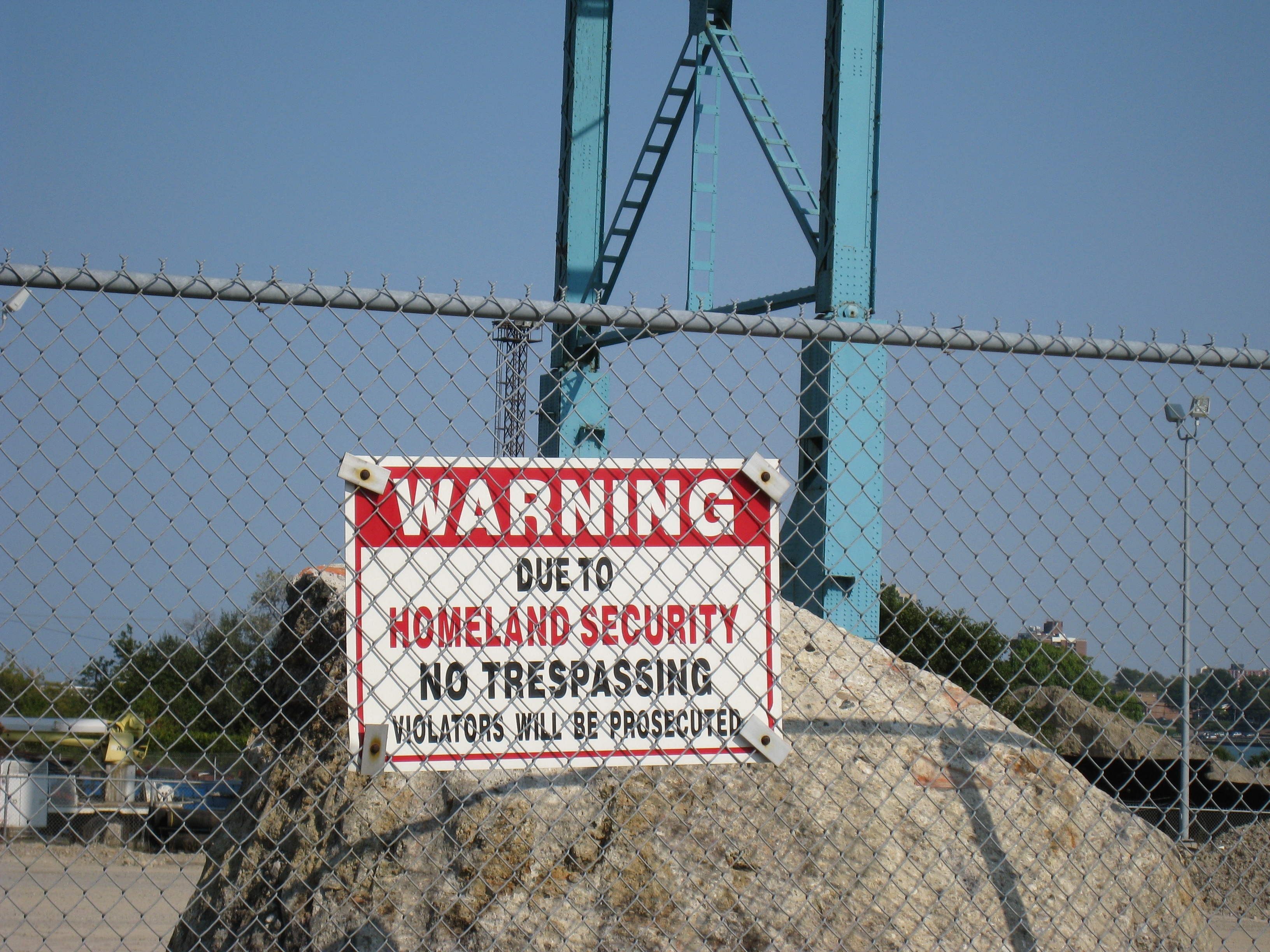
Entrance to City of Detroit boat launch seized by Ambassador Bridge magnate Matty Moroun. Warning sign is bogus -- city officials say Moroun has no authority from the Department of Homeland Security to take over the boat ramp. Joel Thurtell photo.

Entrance to City of Detroit boat launch seized by Ambassador Bridge magnate Matty Moroun. Warning sign is bogus -- city officials say Moroun has no authority from the Department of Homeland Security to take over the boat ramp. Joel Thurtell photo.

trying to take pictures and wound up being chased out by a shotgun-toting goon employed by Ambassador Bridge owner Matty Moroun.

My original goal was to look at and photograph a City of Detroit boat ramp I’d heard was blocked by good ol’ Matty with a phony claim of federal Homeland Security authority.

Next day, I learned that Homeland Security never gave Moroun authority to block the ramp, or to seize part of Detroit’s public Riverside Park and Riverside Extension. So I’m told by city officials.

Matty just made some threatening signs, put them on chain link fences and sealed off sections of the park, including what once was a set of basketball courts in Riverside Park Extension at 23rd Street a block south of Fort.

Warning signs like this one at Riverside Park boat launch and others at Riverside Extension Park were not authorized by federal government, I'm told. Joel Thurtell photo.

Warning signs like this one at Riverside Park boat launch and others at Riverside Extension Park were not authorized by federal government, I'm told. Joel Thurtell photo.

In fact, the reason Riverside Extension looks so small is that Moroun is using the basketball courts to store building materials for his bridge expansion.

Squatters’ rights.

What a guy! Has a huge fortune and still needs to pilfer a public park from cash-strapped Detroit.

I also learned that Moroun’s guards have ejected at least one city recreation worker twice from the same park — nearby Riverside Extension — where a shotgun-armed guard named “Doug” ordered me out on Monday, September 22, 2008.

After “Doug” ordered me to wait so a Border Patrol officer could interrogate me, I left, despite the guard’s feeble try at blocking my car with his company pickup on city property.

With better directions, I found the boat ramp the next day, Tuesday, September 23, 2008. I confirmed that the boat launch area has been padlocked at two spots, and one of Moroun’s bogus Homeland

Padlock reportedly placed by Ambassador Bridge owner Matty Moroun on City of Detroit gate to Riverside Park's public boat launch. Joel Thurtell photo.

Padlock reportedly placed by Ambassador Bridge owner Matty Moroun on City of Detroit gate to Riverside Park's public boat launch. Joel Thurtell photo.

Security signs has been attached to a gate.

I understand city lawyers are thinking of suing Moroun to open the park and put that boat ramp back into operation.

Well, maybe sue him for damages, sure. Sue him to  pay for repairing the park and replacing basketball courts and other equipment he trampled on.

But wait a minute — sue him to take back the city’s own park?

Come on!

Did Matty sue the city to steal the park?

Hell, no.

He just ordered his lackeys to build fences, make ersatz signs and start dumping gravel and concrete on the city park. Anybody who comes close, even on park land, gets bullied off public land.

Why go to court?

Give Matty the bum’s rush: Send a city work crew with bulldozers and dump trucks to tear down the fences and clear out the construction crap. Assign a couple dozen Special Weapons And Tactics cops with heavy artillery to guard the workers. Open up the boat ramp and invite people to bring their boats.

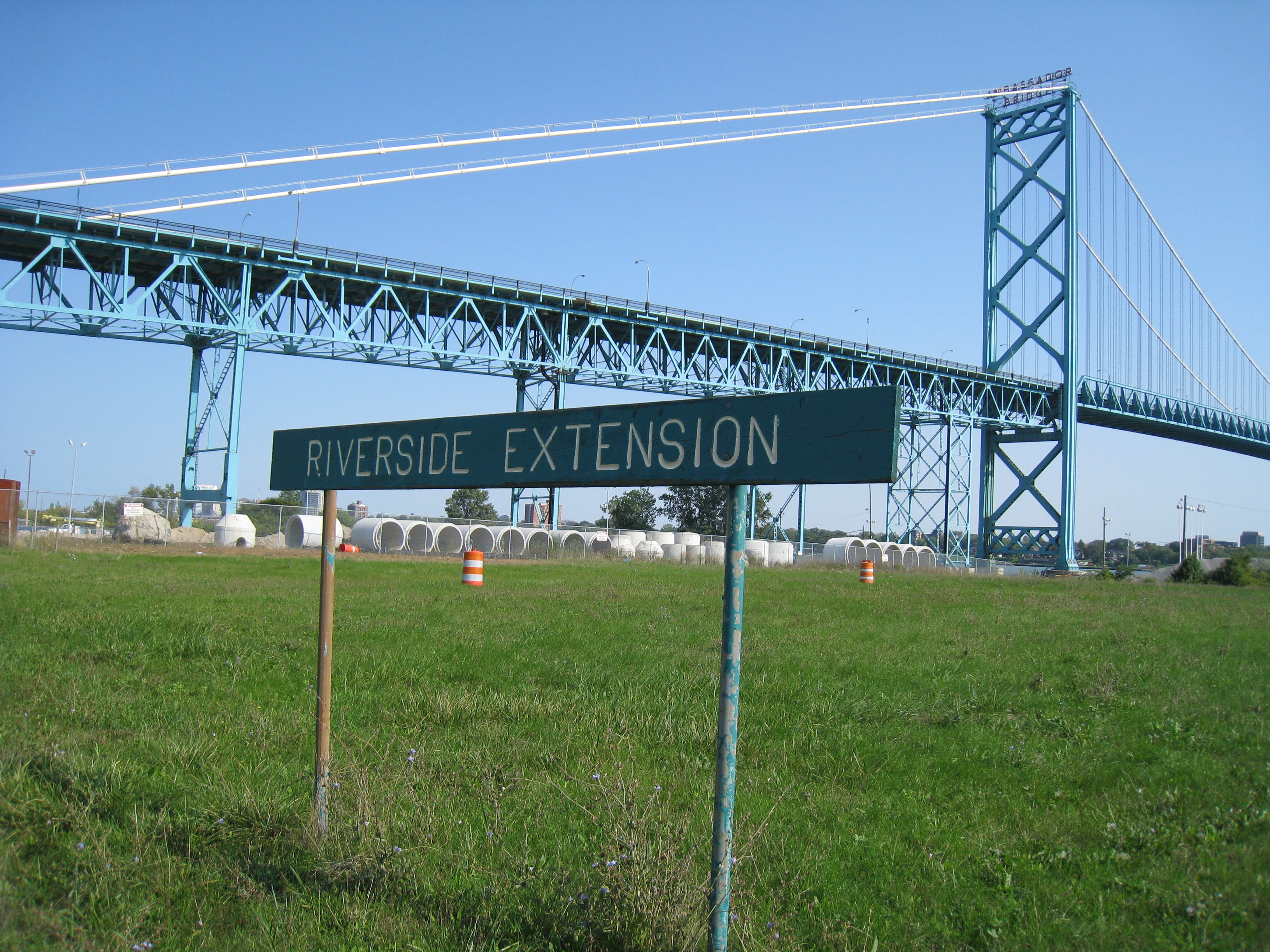
Ambassador Bridge seen from Detroit's public Riverside Park. Joel Thurtell photo.

Ambassador Bridge seen from Detroit's public Riverside Park. Joel Thurtell photo.

I’ll bring my boat. I’d be honored to launch the “Slick” at Riverside Park.

Then assign police to keep an eye on the park. If Matty tries to retake it, to close the ramp, to bring his crud back, why, just send a SWAT team in to push his bully boys out.

Believe me, Doug and his gunslinger pals would wilt at the first sign the city means business.

Drop me a line at joelthurtell(at)gmail.com

Posted in Adventures on the Rouge, Me & Matty | Tagged , , , , , , , , , | 3 Comments

Please don’t look at these pictures!

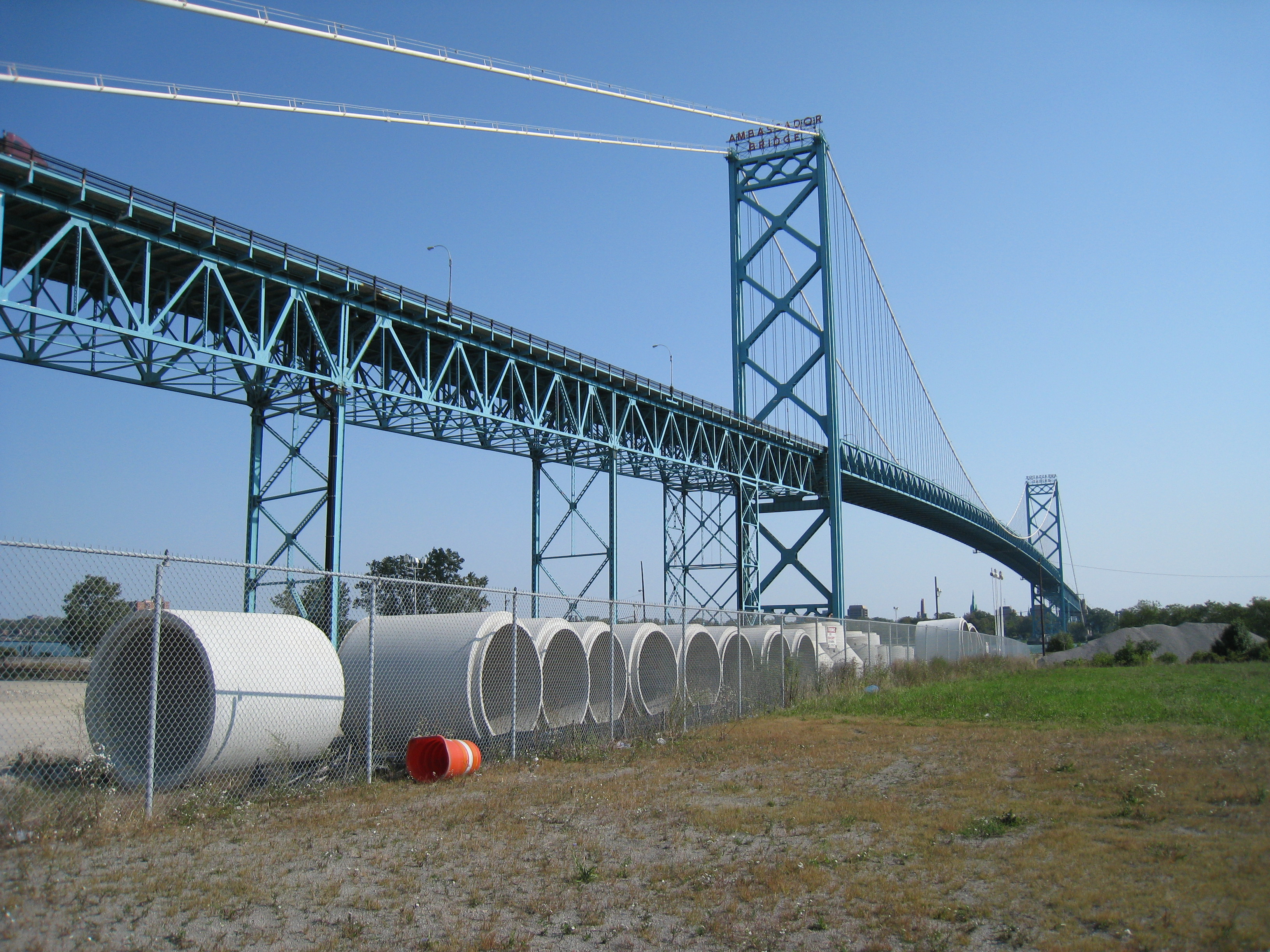
Ambassador bridge w:Riverside park sign

Matty Moroun doesn’t want you to see this photo of his Ambassador Bridge taken with the ball field fence in foreground at Detroit’s public Riverside Park Extension. Joel Thurtell photo.


WANTED: True stories about Matty Moroun

Were you kicked out of a city park by Ambassador Bridge owner Matty Moroun’s goons?

Please post your fond memories of Matty in my comment section.

By Joel Thurtell

Matty Moroun doesn’t want you to see these photos.

In his eyes, they’re contraband. Maybe he’d like them to be seized by the Border Patrol.

The billionaire owner of the Ambassador Bridge has grabbed parts of two City of Detroit Parks and — maybe to cover up his takeover — he’s banned photography from what remains of the publicly-owned park. He claims authority under Homeland Security, but city officials tell me the feds say he’s acting on his own.

I found out about this by accident on Monday, September 22, 2008, while exploring one of the parks.

I almost fell into Matty’s clutches.

One of his gunslingers tried to arrest me for taking photos in the city’s Riverside Extension Park.

Luckily, I made good my escape.

But it’s clear I’d better be careful next time I explore a public park the bridge magnate wants for his own.

Is this kind of harassment by a hireling commonplace? Maybe it explains why nobody was using the park. I have since learned that Moroun’s henchmen had ejected a city parks worker from this same park. Isn’t that outrageous?

Actually, Moroun is treating the parks — Riverside Park on the Detroit River and its extension at 23rd Street near Fort — as his own property. Why, he lets his guards drive across the lawn and push law-abiding citizens around! I saw it. It happened to me.

What he is, fundamentally, is a squatter.

A freeloader.

A rich mooch. I couldn’t believe what happened to me as I peacefully snapped photos at Riverside Extension. For the second time in less than a week, a security guard threatened to sic the feds on me.

First time it happened was Friday, September 19 on the Rouge River as I putt-putted in my motorboat up the freighter docking bay at SeverStal steel mill. A security guard huffed and puffed that I was boating in a “Marine Security Area” and had to get out pronto. He said he was going to take my boat number and report me to the Coast Guard. I reported on this incident in an earlier column, but since have talked to the Coast Guard and learned there are no boating restrictions on the Rouge River. The guard was full of crap. Nor did the SeverStal hired gun ever turn me in. He was REALLY full of crap.

pics matty riverside park fence and concrete drain tubes 9-22-2008

Billionaire Matty Moroun doesn’t want you looking at this photo of his Ambassaador Bridge taken from the City of Detroit’s PUBLIC Riverside Park Extension. Joel Thurtell Photo.

Then on Monday, September 22, I learned about Matty Moroun’s effort to privatize the two City of Detroit parks near his Ambassador Bridge. Rich as Croesus Matty, I’m told, has fenced off a public boat ramp to the Detroit River at Riverside Park off West Grand Boulevard, citing “homeland security” and the need to protect his bridge from…

From what? Kamikaze boats out of Windsor?

It’s a brazen ripoff of public land.

pics matty riverside park homeland security sign and gravel pile 9-22-2008

Billionaire Matty Moroun doesn’t want you to see the construction materials he’s storing on cit of Detroit Riverside Park. Joel Thurtell photo.

I’m also told the city of Detroit is considering suing to make him open the ramp and get off park land. City lawyers are worried that by gradually cramping usage of the park, people will stop coming. Then he can show it’s not being used and offer a low-ball price.

It burns me up to hear of private people — usually rich jerks like Matty Moroun — commandeering public boat ramps. I decided to have a look. Problem was, I didn’t know exactly where Riverside Park is. I wound up in the city park called Riverside Park Extension. It’s a big grassy lot with a ball diamond, a porta-john and a couple of trash barrels. Nobody was using it on that bright afternoon. Soon, I would learn why.

I noticed a chain-link fence on what I took for the park’s perimeter. Clamped to the fence are signs that say, “WARNING DUE TO HOMELAND SECURITY NO TRESPASSING VIOLATORS WILL BE PROSECUTED.”

2 pics matty fake sign

Matty’s phony “Homeland Security” sign. Joel Thurtell photo.

Beyond the signs and behind the fence are heaps of gravel or sand. Later, I learned that the fenced-in area with gravel and threatening signs is actually part of the park. Matty has taken it over. The signs are not from the Department of Homeland Security. He had them made. So Matty’s threatening to prosecute people for “trespassing” in a public park!

3 pics matty fake sign closeI walked along what I took, as I say, to be the park’s border, snapping photos here and there. At the east end, I snapped photos of the WARNING signs and the bridge. All the while, I was trying to figure out how to get to the main park. I could see parts of a green lawn and what looked like a pavilion across a set of railroad tracks.

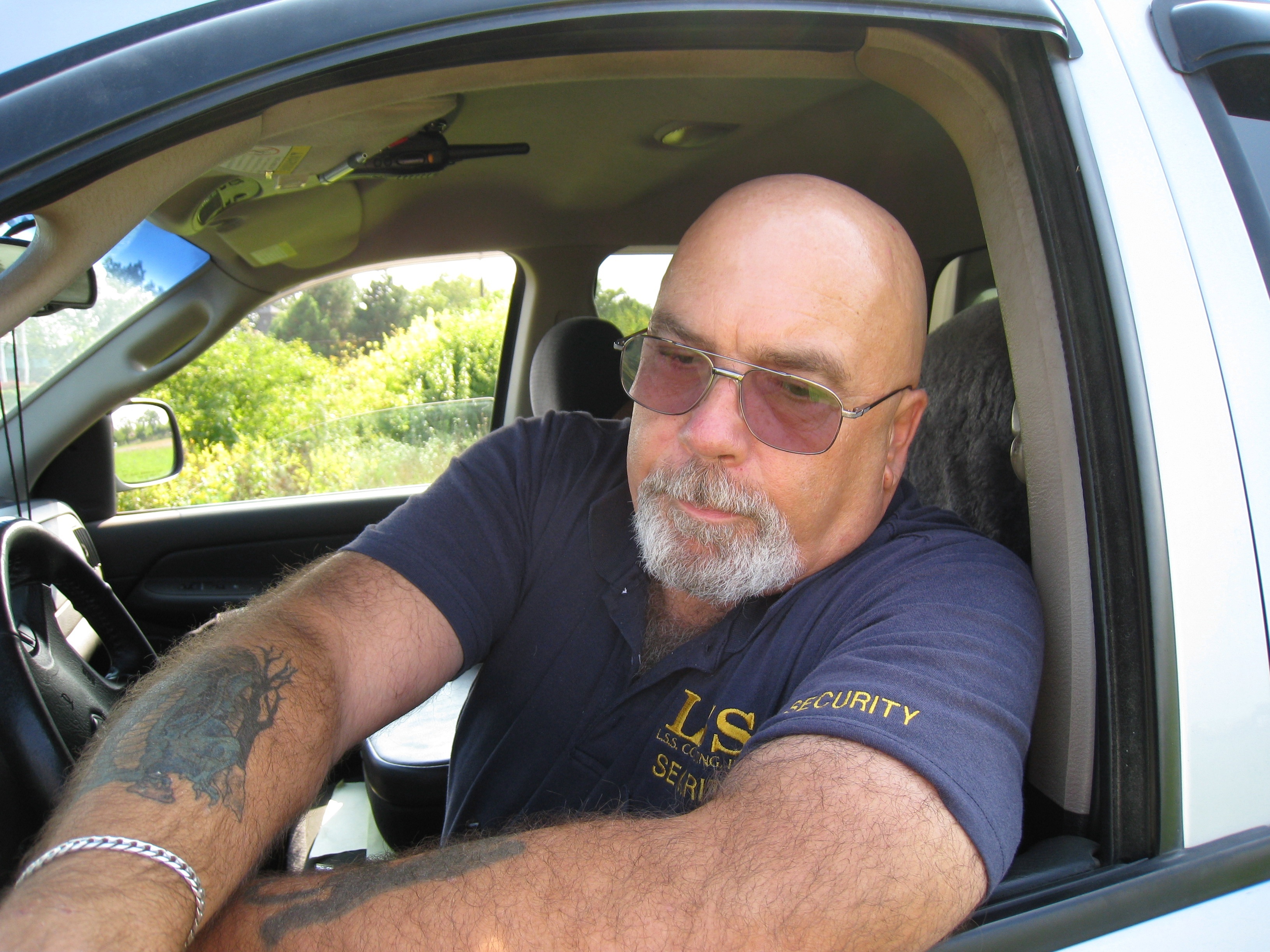
Suddenly, I was aware of company. A guy in a big white pickup truck tore across the park lawn, leaving deep tracks in the grass. I snapped a photo of this guy and the truck as he stopped on the grass beside me.

He was a muscular guy with tattoos on both arms. He had a shaved head and a gray goatee. On the passenger seat beside him, leaning against the seat back, was a shotgun.

pics shotgun totin goon

“Doug” is the name a security guard gave as he tried to stop me from taking pictures in the City of Detroit-owned Riverside Playfield park. He tried to arrest me and hold me for questioning by the Border Patrol. Joel Thurtell photo.”Who do you work for? Let me see your ID,” I said.


“You can’t take pictures of the bridge structure from here,” he said. “Homeland Security. You can only take pictures back where you’re parked.”

“This is a public park,” I said. “You can’t stop me from taking pictures in a city park.”

“You can’t take pictures here. Go back to the parking area.”


I snapped his picture.


4 pics matty pickup copy

Matty Moroun doesn’t want you to see this photo of his henchman, the shotgun-packin’ Doug, leaving deep tracks in grass as he drives across Riverside Park Extension’s lawn on Monday, September 22, 2008, so he could harass me out of the park. Joel Thurtell photo.

He pointed to a decal on the side of the truck: L.S.S. SECURITY (800) 542-3821.

I snapped a picture of the decal.

“What’s your name?” I said.

“Doug.”

“Your last name.”

He pointed to the side of the truck again.

“You need to get out of here,” he said.

“No,” I said.

“Okay, you can talk to the Border Patrol.” He picked up a hand-held radio and talked to someone, saying into it, “I’ve got a guy hassling me here with some cameras. I’ll hold him here till you come.”

5 pics matty LSS Security truck lo res copy

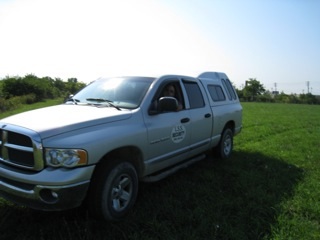
This security company logo on the side of a pickup was all the identification the security guard gave me when he tried to stop me taking photos in a public park and tried to hold me for questioning by the Border Patrol. Joel Thurtell photo

Doug No Last Name put the radio down and told me, “Wait here. The Border Patrol is coming. You can talk to them.”

“No,” I said. “I think I’ll leave.”

“No! You’re staying here!”

“I don’t think so,” I said. “You’re a private security guard and you don’t any authority over me. This is city property.”

I started walking across the grass.

Shotgun Doug backed his pickup and turned around, making a new set of tracks in the lawn. He beat me to the parking area and parked his pickup directly behind my little blue Civic, blocking me from behind.

When I got to my car, Doug The Enforcer told me, “Stay right here. The Border Patrol is on the way.”

“You have no authority,” I said. “You’re a private security dick blocking my car on public property.”

I unlocked my car, got in, started the engine, put the trans in drive and made a sharp right turn forward, spinning past him where he sat in his pickup. I made a quick right on Fort Street and headed for the freeway.

Bye-bye, Dougface.

But of course, Matty won that round — his shotgun-toting goon got me to leave the park.

That’s what Matty wants — to scare people out of this public place so he can call it his.

Got news for you, Matty. I’ll be back.

No shotgun for me. Just my trusty Canon.

Drop me a line at joelthurtell(at)gmail.com

Posted in Adventures on the Rouge, Me & Matty, People | Tagged , , , , , , , , | 65 Comments

Spyin’ on da Russkies


By Joel Thurtell


SeverStal steel mill operation, seen from boat in freighter docking bay on Rouge River Friday, September 19, 2008. Piles of uncovered material, coke?, lie open to wind. Goggles anyone? Joel Thurtell photo.

SeverStal steel mill operation, seen from boat in freighter docking bay on Rouge River Friday, September 19, 2008. Piles of uncovered material, coke?, lie open to wind. Goggles anyone? Joel Thurtell photo.

He had on a blue uniform and was driving a pickup truck, honking his horn like crazy. He strode down to the edge of the dock at the SeverStal steel mill in Dearborn and yelled, “This is a Marine Security Area! You need to leave now! I’m going to take your boat number and report you to the Coast Guard!”


The bluster came from a private security guard at the Russian-owned steel mill as my friend John W. Smith and I patrolled at trolling speed, me snapping occasional photos, up the docking bay once run by an American automaker called Ford Motor Company.

Guess the Russkies don’t like spies.

We were in my little fishing boat, coincidentally and appropriately named “Slick.”

We were touring the Rouge. Never expected to be hassled by Russkies. I’m going to complain to the big boss over there, Vladimir Putin himself.

But now I gotta ask ya, Vladimir, and I’m looking straight into your soul: Where are the signs that

say “Marine Security Area”?


SeverStal steel mill operation, seen from boat in freighter docking bay on Rouge River Friday, September 19, 2008. Piles of uncovered coke and iron ore lie open to the wind. Joel Thurtell photo.

SeverStal steel mill operation, seen from boat in freighter docking bay on Rouge River Friday, September 19, 2008. Piles of uncovered coke and iron ore lie open to the wind. Joel Thurtell photo.

Why, there isn’t even a “no trespassing” placard anywhere around your docks or, for that matter, anywhere along the Rouge.


Wonder why that is, Mr. Putin?

Because it’s a PUBLIC WATERWAY, you vodka-slopping clodpate!

Really, I’ve had it with these self-important factotums who hassle the few people curious enough and gutsy enough to play tourist on the Rouge River.

We’re trying to make people more aware of the Rouge so they’ll care about it. We’re urging people to go to the river, paddle and boat on the river. Why, there are plans to take people on boat tours of the Rouge.

And some of these private companies want to hassle us Rouge tourists?

I’m serious about encouraging people to get to know the Rouge. Three years ago, photographer Pat Beck and I canoed up the Rouge River for a Detroit Free Press project. (Oh, by the way, our book about this adventure, photos by Pat and text by yours truly, UP THE ROUGE! PADDLING DETROIT’S HIDDEN RIVER, will be published in March by Wayne State University Press). On that trip, we stopped alongside a wharf at the U.S. Gypsum Company plant. We were fighting 30 mph gusts in a canoe, trying to avoid being run down by a barge, when four hardhats from USG came up to us where we bobbed on the chop.

U.S. Gypsum plant on Rouge River, taken from boat on water September 19, 2008. Joel Thurtell photo.

U.S. Gypsum plant on Rouge River, taken from boat on water September 19, 2008. Joel Thurtell photo.


Were they concerned about our safety in a fragile canoe facing high winds?

Not at all. Muttering something about “nine eleven,” they demanded to see our ID. So as I sat in the stern of the canoe, I had to dig out of my pocket the baggie that held a photostat of my driver’s license and my Free Press ID.

What did they think? Al Qaeda’s gonna blast their sand piles from a dinky canoe?

Once they learned who we were and what we were doing, they were nice enough. But what if we’d been Joe Citizen without a newspaper ID card?

I can understand the SeverStal guard’s concern: This time I had really potent weaponry. No more canoes. I was piloting a 16-foot fishing boat powered by a 60 hp outboard motor. Maybe he mistook it for a PT boat.

Next time I’ll sweep in with bazooka-totin water-skiers.

“Marine Security Area,” indeed. I’ll tell you how secure this marine area is. The only fish that are “secure” there are carp. Contaminated carp. Fish advisories galore on the Rouge. Don’t eat ’em!


Phragmites, an invasive plant species, tower over concrete pavement that underlies four miles of Rouge River between SeverStal steel mill and Michigan Avenue. Concrete was installed in 1972 by U.S> Army Corps of Engineers to control flooding, but it ensures that fish and other wildllife will have a tough time living with that hard river bottom. Joel Thurtell photo.

Phragmites, an invasive plant species, tower over concrete pavement that underlies four miles of Rouge River between SeverStal steel mill and Michigan Avenue. Concrete was installed in 1972 by U.S> Army Corps of Engineers to control flooding, but it ensures that fish and other wildllife will have a tough time living with that hard river bottom. Joel Thurtell photo.

Why, the water is so polluted in the Lower Rouge you’d never dare swim there. The deep dark scandal of the Rouge is all the toxic sludge on its bottom that nobody wants to talk about. And then, there’s that concrete channel — yes, four miles of the Rouge that were paved, literally, for flood control. If you wanted to design the nemesis for wildlife habitat, it would be that concrete sluice.


Can’t blame Vladimir for that. We’ve done a pretty good, red-blooded American job of ruining this waterway.

Ride in a boat on the Rouge near SeverStal, or for that matter near the Detroit Wastewater Treatment Plant or the U.S. Steel iron-making plant on Zug Island. Better hold your nose.

A few years ago, I was writing about air pollution at U.S. Steel. By the smell on Friday, September 19, as John and I idled the Slick past this plant, nothing has changed. Hydrogen sulfide, by the stench of it. I flew over these blast furnaces three times — twice in a helicopter and once in a blimp. Always the same wretched stink, even at 1,200 feet.


Conveyor moves ore or limestone from uncovered piles on south side of Rouge River to north side where it enters SeverStal iron-making plant. Boaters traveling underneath conveyor should have goggles, as grit falls off conveyor into river and into human eyes. Joel Thurtell photo.

Conveyor moves ore or limestone from uncovered piles on south side of Rouge River to north side where it enters SeverStal iron-making plant. Boaters traveling underneath conveyor should have goggles, as grit falls off conveyor into river and into human eyes. Joel Thurtell photo.

We drove the boat under a conveyor that spans the Rouge at SeverStal and rubbed the grit out of our eyes. Yep, the conveyor trasnports some kind of grimy crap over the river and, of course, no machine being perfect, some of the grime drops into the River or sticks in your eyes on its way down.


Huge uncovered heaps of coke and other materials I can’t identify. Ore? Limestone? Whatever it is, the dust rises and gets whipped by the wind. When Pat and I paddled the canoe past here in 2005, with high winds, we had grit in our eyes for miles.


Pile of uncovered salt alongside Rouge River at Morton Salt facility on Rouge River. Joel Thurtell photo.

Pile of uncovered salt alongside Rouge River at Morton Salt facility on Rouge River. Joel Thurtell photo.

Think about it: Uncovered piles of salt at Morton Salt, cement at LaFarge Cement, heaps of gypsum at U.S. Gypsum, coke, slag and other materials at the two iron-makers. Not to mention the stench from the Detroit wastewater plant and more from puke-inducing fumes from a city contractor’s composting operation.


We saw what looks like an inflatable oil containment boom at the west end of the Turning Basin at the Severstal plant. Wonder what that means?

I noticed there are still twin booms at the city of Detroit’s O’Brien Drain, the infamous creek where huge amounts of oil emerged into the Rouge in 2002. It’s still happening, I guess, given the presence of the booms, which are inflatable tubes that supposedly stop the lighter-than-water oil from entering the Rouge, but don’t. Last year, just before I retired from the Free Press, I wrote about a spill of several hundred gallons of oil from this drain just east of the I-75 bridge.


Oil containment boom at O'Brien Drain east of I-75 bridge on Rouge River in Detroit. Six years ago, huge amounts of oil spilled from the Detroit sewerage system into this drain and on into the Rouge. Even now, oil flows occasionally into the Rouge through this drain, hence the containment boom. Joel Thurtell photo.

Oil containment boom at O'Brien Drain east of I-75 bridge on Rouge River in Detroit. Six years ago, huge amounts of oil spilled from the Detroit sewerage system into this drain and on into the Rouge. Even now, oil flows occasionally into the Rouge through this drain, hence the containment boom. Joel Thurtell photo.

So the guard wants to report us to the Coast Guard. “Fine,” I said. “Go ahead.” I put the Slick in reverse and backed away. Hard for a renta-cop to arrest you if you’re in a boat and he’s in a pickup truck. At trolling speed, I drove the Slick back towards the Turning Basin where ocean-going ships reverse course. Suddenly, John noticed the red flash of molten iron being poured. I turned the Slick around for a better photo.


Honk! Honk! Honk! Vladimir’s lackey was really pissed now. I’d disobeyed him.

He’s going to report me? For what? Driving my boat on public waters?

You know, I decided, by gum, I’m gonna report him

I’m going over his vacant head.

Take this message to your leader, you Commie-lovin stooge.

Tell him, you running dog of Red iron-makers, that joelontheroad knows something about marine security.

Never mind, I’ll tell him myself, since his old KGB pals probably tapped my computer.

Hey, Vladimir — Clean up your friggin steel mill, good buddy.

Cause I’m comin back.

Yep, comin back in my little 16-foot PT boat.

Comin back to your little marine insecurity area.

No bazookas, Vlad. Just my little Canon.

Vlad baby, I’m gonna keep spyin on you Russkies.

Drop me a line at joelthurtell(at)gmail.com

Posted in Adventures on the Rouge | Tagged , , , , , , , , , , , , , , , , | Leave a comment

Cliche-Makr ™ and the Times

[donation]

By Joel Thurtell

From: Ralph Stinkline, Usage Editor

The New York Times

To: Wilbur Frazehacker, CEO

Cliche-Makr Corp.

Dear Wilbur,

I wanted to give you a progress report on the implementation of our new Cliche-Makr Wordbustr Mark II Linguistic Processing Machine (CMWM II LPM) here at the Times, the world’s best newspaper.

What a marvel!

I think this machine will make the best newspaper in the world even better, if that is possible.

Before, when a reporter was short on time and pressed for words, he or she was forced to sweep through his or her own personal memory of the best hackneyed phrases for a particular writing assignment.

Now, thanks to your machine, the CMWM II LPM, our reporters need only punch a code into their personal computers to have revealed to them, thanks to the genius of your Cliche-Makr technology, a listing of acceptable tritenesses for their immediate usage.

As we both know from private studies, readers adore cliches and can’t get enough of them. The problem is not demand, but supply. And you geniuses at Cliche-Makr have at last found the Rosetta Stone of newspaper writing. The supply of cliches can be now unending.

Rather than go into great detail about how well this machine has been adapted in our New York Times newsroom here in Manhattan, home of the world’s best newspaper getting even better, I’d like to print out for you some examples of recent usages coined by Timesmen and Timeswomen using your miraculous machine.

I think you will agree that no mortal human equipped even with the highest degree of IQ could have concocted a string of chestnuts equal to a single paragraph in the Sunday, September 21, 2008 New York Times, the world’s best newspaper. The reporters had free usage of your latest iteration of the CMWM II LPM.

I chose a story created by three reporters — Peter Baker, Stephen Labaton and Eric Lipton — because it seemed to present the greatest challenge to the Cliche-Makr Wordbustr Mark II technology. In my experience as Usage Editor at the New York Times, which is the world’s greatest newspaper, it is difficult to get one reporter to agree with him or herself on the choice of cliches for an article, let alone find concordance from three fully Type A ego-equipped journalists. So three reporters on one story was a real test of the machine’s capacities.

I estimate that the time required to compose this very long Page One story was 48.2 percent less than the same story would have required using human cliche retrieval capacity.

Here is what our trio of wordmeisters came up with using the CMWM II LPM. I begin with the nut graff, which I think is a classic of tritelian efficiency:

This was one of two lead stories on Page One with the headline, ADMINISTRATION IS SEEKING $700 BILLION FOR WALL ST.; BAILOUT COULD SET RECORD. Our story was set under the subhead, “A Professor and a Banker Bury Old Dogma,” and is about Federal Reserve Board Chairman Ben Bernanke and Secretary of the Treasury Henry Paulson Jr.

The nut, or cosmic, paragraph reads: The plan to buy $700 billion in troubled assets with taxpayer money was shaped by two men who did not know each other until two years ago and did not travel in the same circles, but now find themselves brought together by history. If Mr. Bernanke is the intellectual force and Mr. Paulson the action man of this unlikely tandem, they have managed to create a nearly seamless partnership as they rush to stop the financial upheaval and keep the economy afloat.

Isn’t that a masterpiece, Wilbur? Could a human being have created something as goshdarn wonderful as the Cliche-Makr wrote in that pearl of a nut graf?

…but now find themselves brought together by history.

Wow! I know, some people will say baloney, we’re all brought together by history, or not. But nuts to the naysayers, I say! Readers love these tried and true bromides. They make them feel warm and cozy in these troubling times.

Don’t you just love expressions like action man and intellectual force and unlikely tandem?

I LOVE “unlikely tandem.” Doesn’t it make you think of that song, “A Bicycle Built for Two”? It challenges the intellect, yet it pacifies. Wonderful!

And this one: seamless partnership. Isn’t that a beauty? Only a machine could have contrived that one, Wilbur.

And then comes they rush to stop the financial upheaval and keep the economy afloat, followed by historical underpinnings, followed by dire threats, followed by starkly different, followed by pounding the phones, lofty terms, odd couple, characteristic intensity, lawmakers were shaken and more diamonds in the Times ruff too numerous to count.

Did we hit a home run or not, Wilbur?

Yours truly,

Ralph Stinkline, Usage Editor at the Best Newspaper in the World

From: Wilbur Frazehacker, CEO

Cliche-Makr Corp.

To: Ralph Stinkline, Usage Editor at the Best Newspaper in the World

Dear Ralph,

Thanks for your very kind words. It is gratifying to know that our artificial cliche machine is so well appreciated at the Best Newspaper in the World. I’ve been a loyal New York Times reader for many years and I know that even your paper’s human-created cliches are better than those at other papers such as the Wall Street Journal and the Washington Post. I’d be willing to bet on a typical day the Times turns out more wonderful cliches than both of those newspapers combined. Especially since neither of them has yet popped to buy a Cliche-Makr Wordbuster Mark II Linguistic Processing Machine (CMW MK II LPM)!

But I’d like to point out to you, Ralph, that there is actually icing on this prodigious cake. Did you notice the cliches contained in the direct quotations from outside sources? Man oh man, Ralph, there were world-class trititudes in there. How about this one, from someone named John H. Bryan Jr.: He is a hurricane. He is used to living in a turbulent world.

It is not every day that you can inspire regular people called up by newspaper reporters and put on the spot to say something intelligent and hear them say, with Allen S. Blinder, He looked like he had the weight of the world on his shoulders. Only a fine cliche grinder can do that.

Or how about this, again from John H. Bryan Jr.: He has lived in a world of deadlines, decisions and pressure-packed things.

Even the lede sentence contains classic proportions, like as the nation’s economy lurched from crisis to crisis. A gem!

The beauty of this article, Ralph, is in the sheer abundance of the cliches. It is a sort of protection from those nitpickers and troublemakers who might otherwise spark a fight over the alleged “overuse” of cliches. (We both know that is impossible!) The sheer number of cliches in this piece makes the effort of complaining nigh onto impossible, requiring an expenditure of mental capital so extraordinary that a normal human would not attempt it.

What moron would think to ask whether we don’t all live in a world of deadlines, decisions and pressure-packed things? And if we do, such a moron might wonder if maybe each of us is as qualified to be Secretary of the Treasury or Chairman of the Federal Reserve Bank as Bernanke and Paulson.

Don’t worry, nobody will think of that!

Thanks again for letting us know here at Cliche-Makr Corp. that our machine is doing what you need it to do.

Your friend,

Wilbur Frazehacker, CEO

Posted in Joel's J School | Tagged , , , , , , , , | Leave a comment

Bing-O! He helped oust Kwame, now wants job

[donation]

By Joel Thurtell

Was I on the money, or what?

Dave Bing, the Detroit businessman and onetime basketball star who pressured Wayne County Prosecutor Kym Worthy and Jennifer Granholm to remove Kwame Kilpatrick as mayor of Detroit, now wants — guess what?

To be mayor of Detroit!

Gosh, what a surprise.

Anyone NOT see that move coming?

Okay, I’m going to steal a move from the Detroit Free Press and pat myself on the back. I predicted this one. Here’s what I wrote in joelontheroad.com on August 20:

And then there were those mega-business guys, Dave Bing and Pete Karmonos Jr. pressuring Wayne County Prosecutor Kym Worthy to cut a plea deal with Kwame that would safeguard his law license but get him off stage so someone else could run the city with honor and dignity.

Who did they have in mind?

Journalists should never use “talk on the street” as a source for articles, so I won’t note that talk on the street had Dave Bing crowned as mayor to fill in the blank left by Kwame’s removal, should it happen.

The idea that a bunch of self-appointed business folk would interfere in a judicial proceeding is repulsive. Twisting the prosecutor’s arm, aided and abetted by trumpeting Detroit Free Press columnists, sounds to me like something akin to obstruction.

I’ll say it again: I’m no fan of Kwame. It wasn’t his affair with old pal and Chief of Staff Christine Beatty that offends so much as their apparent effort to cover it up by hiding text messages — love letters, really — that appeared to make liars of them and betrayers of the public that elected Kwame.

(Note my use of “apparent” and “appeared”? Unlike my rival media organism, the Detroit Free Press, I recognize that Beatty still faces trial and is presumed innocent till proven guilty beyond a reasonable doubt, which so far the Free Press has not accomplished despite their inflammatory lingo.)

But what really offends me about this whole situation, and it includes that newspaper I just mentioned, is the way so many leaders — politicians, business people, preachers and, yes, self-styled journalists — jumped aboard the railroad highballing toward preventing a fair trial. (Remember that Beatty is going to try her luck with a jury, so there’s still plenty of opportunity for the media to louse that up.) That railroad was first the City Council’s try at a kangaroo cout, aka “hearing,” that would have tainted potential jurors for a criminal trial. And then that boneheaded move being forbidden, they persuaded the governor, no doubt worried about how Kwamegate might hurt Democrats in the November elections, to hold her removal hearing, which helped force Kwame to plead guilty. Granholm’s hearing was a sham, too, just another turn of the screw.

Once Granholm convened her hearing, Kwame’s chances at finding jurors with minds unpolluted by the media din were nil.

Due process?

This train was made in Detroit.

And now one of the chief promoters of the hearings and the prosecutor’s “deals” has shown us his hand.

Dave Bing wants the job he helped create.

Good luck, Dave.

But I gotta tell ya, those deft moves you had on the basketball court sure didn’t translate to politics.

I didn’t need a courtside seat to spot your self-interested motives.

Stealth, good buddy. Stealth.

You’ll need it in Detroit.

Drop me a line at joelthurtell(at)gmail.com

Posted in Joel's J School, Kwamegate | Tagged , , , , , , , , , | Leave a comment

The art of writing bullshit

[donation]

By Joel Thurtell

Tea leaves anyone?

I just received the latest missive from Detroit Free Press Editor Paul Anger, addressed to the Free Press staff.

It makes me wonder what a Bach fugue would sound like if you left out the counterpoint.

In reading this memo, which I plan to reproduce in all its boring entirety, please keep in mind that this Pulitzer-lusting newspaper is operating with a photography staff short Chief of Photography Kyle Keener, whom Anger in his wisdom fired and then didn’t replace; Amy Leang, a veteran staff photographer, is taking a hike, no replacement; and super-veteran photographer Mary Schroeder (remember the Free press poster photo of Kirk Gibson leaping in jubilation at the Tigers’ World Series win in ’84? That was Mary’s work) is going to be an editor, with no apparent replacement.

You’ll notice it as the paper runs more and more wire photos, but you won’t see it in the Anger memo.

The photographers are busting their buns because Gannett is too cheap to replace people. Well, what did I think? The buyouts were meant to REDUCE staff levels, let those who remain fend for themselves.

You won’t get that from this morsel of mendacity.

This institution, remember, has bought out almost 40 veteran staffers in most every editorial department over a half-year period, without replacing them.

Nothing about staff levels here.

The people who remain are stressed, fried, looking for exits.

But, will wonders never cease? Managers have engineered a deck-chair dance as this newspaper Titanic marches towards the drink.

It is a masterpiece of prose subterfuge. What it does say is beyond belief. What it fails to say is the real story. Just one example: Ron Dzwonkowski is without a doubt the smartest, most knowledgeable editor on the staff. The guy is a genius at comprehending and organizing complex journalistic problems. Ron was my editor on several investigative projects in the 1980s and early 1990s, and his ability to grasp what a story really is about is just phenomenal. His talent for analyzing evidence is simply unsurpassed.

There was the stolen gun story, his idea, executed by me, in which I traced the multitude of owners of a revolver that was stolen from a Kalamazoo cop and wound up killing a kid in Ann Arbor. There was the Capital Appreciation Bond story, about an arcane topic — municipal bonds — that most business reporters don’t cover let alone fathom, but which Ron grasped as a huge driver of Michigan school debt. There was the immense amount of fraud being perpetrated in the 1980s by school districts all over the state that were stealing millions in state aid by falsifying their adult education student rolls. Those were stories that, to borrow an ancient Free Press slogan, Made A Difference. Thanks to Ron.

Believe me, an editor like Ron is a rarity at the Free Press, despite all the hyperbole and cow stool you will wade through below.

I could go on. The guy is a wonder. Reporters worshiped him. You could be all the way on the other side of the state, deadline breathing down your throat, a pilot waiting to fly you back to Detroit and sources just about ready to give up the info and you’d call Ron and know at the other end of the line there was a colleague who could grasp just what your stresses were. But then, Ron was an Associated Press reporter before coming to the Free Press. He traveled to every down big and small in Michigan and could visualize the very pay phone you were calling him from. Unlike many editors, he knows what a reporter does.

Yes, a REAL editor.

Funny how Ron never made City Editor. The best man for the job. He would have been a brilliant choice.

Wonder why. Of course, I know why. I’ll get into that verboten territory in another column.

City Editor? Didn’t happen. He ran projects, then was assigned to oversee the editorial page. An important job, no doubt, but Ron is a NEWS person. Still, far as I can see, he did a great job as editorial page editor.

I’m reading the blurb Paul Anger signed but most likely didn’t write about Ron. What does it say? What will Ron be doing? Make like Dave Robinson, another talented editor who was too smart for Gannett, and take a buyout?

Why publish such dreck? Why not just do what you’re going to do without dishing out all the feces?

Okay, here it is. If you enjoy double-talk, this should be fun.

Newsroom Leadership

Name: Jody Williams
Published on: September 18, 2008 02:45 PM

Sept. 18, 2008

To the Free Press Staff,

From Paul Anger

I’m excited to make several announcements related to our core leadership structure. With one exception, they are effective Nov. 10, and Executive Editor Caesar Andrews will be in place until then.

I want to emphasize that I am very proud of the following folks. They epitomize the talent and dedication that so many staff members bring to this newsroom, every day:

AME Ritu Sehgal will become Deputy Managing Editor for News and Features. Ritu brings a sense of purpose and focus to everything she touches, including her work with Metro, the Investigative Team and now our Features and Entertainment departments. Ritu’s counsel and editing contributions have been indispensible to our mayor coverage. Her new title matches her broadened responsibilities and how effectively she’s handling them.

AME Steve Dorsey will become Deputy Managing Editor for Presentation and Innovation. Steve brings a wealth of creativity to this newsroom and is one of the key people in this building working on our new IDEO project. His impact on where we’re headed is profound and expanding — he’ll take on supervision of our news desk, continue to oversee design and graphics, and become more involved with Web design. He will work closely with Julie Topping as we restructure our editing processes.

Deputy Editorial Page Editor Stephen Henderson will become Editorial and Opinion Editor, in charge of the editorial pages of the Free Press and our increasing emphasis on commentary and blogs on Freep.com. Steve has had a tremendous impact with his own columns and his vision for online commentary. He knows this city and the greater community, and standing alongside Ron Dzwonkowski, he has helped enhance Free Press leadership in Detroit and Michigan. Steve will begin his new role in January.

Editorial Page Editor Ron Dzwonkowski will become Free Press Associate Editor. After 10 outstanding years, and after having hand-picked his successor in Steve, Ron will move into these wide-ranging duties: He’ll write a weekly column, blog, edit some other news/opinion columnists, and also edit selected high-impact enterprise projects from time to time. Ron’s leadership inside and outside of this building cannot be overstated. As Associate Editor, Ron will continue to have his own unique impact on our best journalism. After the general election, Ron will begin transitioning into his new duties.

Managing Editor for Digital Media Nancy Andrews will continue to oversee Photo-Video and our expanding digital efforts, including Freep.com enhancements, current and future niche sites, broadcast opportunities and new ways of delivering digital information. As our Web traffic has soared and we’ve assumed leadership in multi-media across the country, Nancy has had increasing impact not just in our newsroom but also with the Detroit Media Partnership and across Gannett. To say she’s been an innovator and leader of change is…..understatement.

ME/Newsroom Operations Julie Topping will have a simplified title — Managing Editor. Julie will continue as our point person for issues related to production, advertising and marketing. She will continue to oversee our editing and the restructuring of our copy desk and will work with Steve Dorsey on design and graphics. She will also take on these duties — handling syndicated material and news wires, coordinating newsroom recruiting, helping to expand newsroom training, and overseeing a new Sunday real estate tab now under development. Gene Myers and the Sports Department will begin reporting to Julie as well. Julie brings broad knowledge, organizational skills and leadership deep and wise to all parts of this newsroom, as reflected in her new title.

And finally: ME/News and Features Jeff Taylor will become senior managing editor, with all the duties and responsibilities that title carries. Jeff will oversee newsroom functions and report directly to me. Jeff has had the highest impact in this newsroom in a variety of ways — with Sports, Metro, the Investigative Team, Features, Business. He has been a catalyst in connecting departments across the newsroom to share reporting resources and to support each other, which is more critical than ever now. He’s always been laser-focused on getting our best, most exclusive journalism into the newspaper and onto Freep. He’s handled the most complex stories we’ve ever produced.

I’m excited about Jeff’s role, about our entire leadership team and the folks who are stepping up. And I want to say, again, that they represent the tip of the iceberg — I am proud of the many people doing wonderful things every day across the newsroom. This leadership team is dedicated to supporting all of those efforts.

— Paul Anger

There — that’s it, in half a dozen nutshells.

Thoughts, anyone?

Drop me a line at joelthurtell(at)gmail.com

Posted in future of newspapers, Joel's J School | Tagged , , , , , , | 2 Comments

All my sins — and more

[donation]

By Joel Thurtell

Man, are my ears burning.

A reader named “Ricky” really socked it to me in a pair of caustic comments last weekend.

I’m still reeling. My sense of self is in total tumult.

Don’t know where to turn.

Guess I’d better write.

Yep, “Ricky” really bore into the core Joel. Got me where I live.

Here’s a list of my sins, as perceived by “Ricky”:

I’m a pontificator.

I’m inconsistent.

I’m a newspaper reporter.

I’m white.

I’m a white newspaper reporter.

I’m racist.

I’m a racist newspaper reporter.

I’m a white racist newspaper reporter.

I tell you what, the slur that stings the most is the one about my being a newspaper reporter.

“Ricky” is clearly a newcomer to joelontheroad.com, or he would know that I most definitely am NOT, doggonit, I repeat, NOT NOT NOT a newspaperman!

A blogger, yes.

A bloviator, sure.

A fulminator, and yes, okay, a pontificator, most certainly.

(Check out the length of the first comment “Ricky” posted and tell me if maybe “Ricky” hasn’t picked up some bad habits from me in the pontification department)

But back to this newspaper thing. “Ricky,” I quit newspapering the way others quit smoking. Well, okay, that’s something of an exaggeration. I was paid to quit my habit. Took the Gannett Grant, aka a buyout, and walked out of the Detroit Free Press newsroom in November 2007. That makes almost a year that I’ve been newsroom-free. One day at a time, “Ricky,” but I’m doing it, I’m kicking the habit, killing the curse and I’d appreciate a little credit for the extraordinary will power it takes every minute of every day to keep from going back to newspaper reporting.

So please, please don’t malign me by calling me a newspaperman.

Now, what about that inconsistency thing?

My first reaction is simply to say with Ralph Waldo Emerson, “A foolish consistency is the hobgoblin of little minds, adored by little statesmen and philosophers and divines.”

And, of course, by “Ricky.”

Unlike “Ricky,” I don’t take the low road of ridicule, so no ad hominem wisecracks about his being probably a step or two removed from a divine. Nor will I bloviate on as “ricky” does about how I’m typing slowly so even a dimwit like “Ricky” will get my drift. No sir, no ad hominem ad nauseum in joelontheroad!

I’m not going to come back, either, with that Emerson wisecrack about consistency and hobgoblins, because what the hay, sometimes a little inconsistency can be just what the doctor ordered.

Besides, on second thought, I realized “Ricky” didn’t fully understand what he was pontificating about. Maybe he should have typed a little faster.

There’s a little inconsistency in “Ricky,” too.

Better retain inconsistency on my side as a Bad Thing that “Ricky” is guilty of.

Here’s what “Ricky” had to say:

I don’t get you. Your essay on Conyers is excellent. The reporting is the type of stuff a paper should do. But where is your consistency?

You are a white man working for a white-run paper and you want an Ethics Committee in Washington to take action (bring down) a black Congressman elected by a mostly black Detroit district?

Heck, the local resident got the info. They could recall him. But they didn’t. So now mostly white outsiders should remove him?

You bitched about that when Kwame came down. So what’s different? Other than this was your story?

Well, “Ricky,” regarding the recall of Conyers, that’s not a bad idea. Except that white or black, when was the last time you heard of a congressman being recalled?

What’s different, “Ricky,” is that the constituents of John Conyers Jr. did not get the full story.  The Free Press dropped it posthaste. Thus, there was no development of the Conyers story, unlike Kwamegate, where the Free Press seemed to have standing orders that anything about Mayor Kilpatrick was Page One.

See what I mean? Apples and oranges, “Ricky.” No inconsistency with joelontheroad, but plenty on your side. Following your example, I typed that REAL slow.

And for good measure and at the risk of pontificating, I’ll repeat: In the case of Conyers, the story was choked off. In the case of Kwame, it was over-stoked. Yet even with all the hype, and with plenty of history of mayors and council members being recalled in Michigan, a recall movement against Kwame never got legs.

I’ll recap my recapitulation: There was no media echo chamber for Conyers. Not even a ghost of one. Curiously, the story was not picked up by national newspapers like the New York Times, Washington Post or Los Angeles Times, though they were fully aware of it. Doesn’t that seem odd? There was a period of time when the Republicans were taking hit after hit on ethics, and the New York paper I mentioned would, yes, pontificate about it once a month on its editorial page.

Those were, with one exception, white congresspeople who were being lambasted. Not a mention in the elite papers about Conyers. Odd? An understatement.

Without a press interest in the Conyers story, it was easy for the moribund House Ethics Committee to drop his case.

As to my “racism,” well that is such an easy thing to say, and generally so meaningless, that it usually refines down to nothing more than a taunt, an attempt to get one’s goat, like making mock of your mother. The object of such a jibe usually is to tip the scales of argument, to appeal to latent white guilt about slavery and segregation, to put the recipient of the slur on the oratorical defensive.

And here comes “Ricky” trotting out his “Uncle Tom” remarks.

Uncle Tom. My, my.

Lacing phrases like “uncle Tom” into your prose is meant, I know, to further embarrass and “out” me as a racist.

I should feel righteously castigated, I know, my evil ways having been exposed in such a forceful screed typed very slowly by the dreaded “Ricky.”

Instead, reprobate that I am, I’m thinking of what Dr. Johnson said about patriotism.

I’m thinking it applies equally to people who accuse other people whom they’ve never met of being racists.

An old rhetorical trick? Indeed.

And still it is the last refuge of a scoundrel.

Drop me a line at joelthurtell(at)gmail.com

Posted in Joel's J School, Kwamegate | Tagged , , , , , , , , , , | Leave a comment

The REAL holy grail?

[donation]

By Joel Thurtell

It was bad enough that the Detroit Free Press on Monday, September 16, 2008 failed to mention on Page One the bankruptcy of the huge Wall Street investment bank Lehman Brothers or the sale of the huge Wall Street brokerage house Merrill Lynch or the devastation visited by the huge wind known as Hurricane Ike on Galveston, but saved 1A room for an update nonstory about Mayor Kilpatrick’s onetime chief of staff and lover, Christine Beatty.

That was my hastily-drawn conclusion as I drank coffee and psyched myself up for working on my latest book. I put the Freep down and got all I needed to know about Lehman, Merril Lynch and Ike from the New York Times.

But some Free Press staffers — and readers — noted the same lapse, though “lapse” seems an inadequate mot for describing a newspaper’s obsession with plowing furrows in the Kwame story even after the harvest.

The staffers looked in vain through the entire print version of the paper for any mention of Lehman and found none. Frankly, I had assumed the paper’s editorial people could not have been so lame as to have totally ignored the failure of a firm whose fall caused the Dow to fall more than 500 points.

By ten in the morning, the Free Press had posted the Lehman story on the Web. Big deal. It doesn’t take a journalist to see which way the Web stories are blowing and post a copycat item.

The Free Press addiction to Kwamegate caused it to drop the ball big time for the readers it claims to serve, while the New York Times and the Detroit News put Lehman on Page One.

But at least the Freep had it on the Web.

The Web, the Web,

In the past, I’ve written that the Pulitzer Prize has become the Free Press’ compulsive quest in its Kwamegate coverage. I’m beginning to think the Pulitzer is chump change in comparison to the paper — and owner Gannett’s — premier obsession: the Web.

I wonder if the redlining I’ve been describing — the wholesale lopping of huge areas of readership from Free Press and News delivery routes and orders to writers to stop covering those areas — isn’t part of a self-created, self-fulfilling prophecy.

The more circulation declines, the more the newspaper is justified in dropping its print version altogether and publishing only on the Internet.

Could it be that they WANT their circulation to go down? I’ve argued elsewhere (see my blog category, The Future of Newspapers) that the demise of American newspapers is self-inflicted. I’ve also repeated the old saying that “newspaper people brag about their drinking and lie about circulation.”

I assumed they were lying upwardly.

But I’m hearing anecdotes about the papers’ refusal to deliver papers to suburban convenience stores and cutting readers in western Michigan. I know from my 23 years of experience at the paper what was happening to city of Detroit deliveries and I had orders not to write about parts of Detroit and many suburbs.

Could it be that the direction of the lying now is downward?

Is it possible that managers want to persuade shareholders that readership is so damaged they have no choice but to stop printing and go Web only?

Drop me a line at joelthurtell(at)gmail.com

By ten in the morning,

Posted in future of newspapers, Joel's J School, Kwamegate | Tagged , , , , , , , | Leave a comment

Free Press editor: “Everybody does it”

[donation]

By Joel Thurtell

In previous posts (see my blog category JC & Me), I wrote about how the Detroit Free Press clamped down on my reporting on ways U.S. Rep. John Conyers Jr. of Detroit abused his congressional staffers by making them work on his and other political campaigns on federally-paid time, in apparent violation of ethical and legal restrictions on office-based politicking.

When I proposed to an editor a couple years ago that the paper re-open the Free Press Conyers investigation, his response was that “everyone does it,” meaning every U.S. rep and Senator does what Conyers reportedly did — make congressional staffers do campaign work, including travel to distant cities sometimes for protracted stays — while being paid supposedly for doing work to help constituents.

“Everybody does it,” I guess means in even broader terms, everybody is violating ethical guidelines and committing fraud, therefore the Free Press won’t write about it.

Somehow, that ethical pronouncement didn’t apply to Detroit’s soon-to-be ex-mayor, Kwame Kilpatrick.

Maybe if Kwame was a congressman with federal clout he could have bucked the perjury case, maybe even bulldozed the newspaper into suppressing the story and re-assigning the reporters to a suburban, aka “Siberia,” beat.

No such luck for Kwame.

“Everybody does it” is an apt term for describing the state of suppressed governmental lawsuit settlements throughout Metro Detroit.

If the Free Press had wanted to do some REAL Pulitzer-grade work, they could have conducted an exhaustive analysis of ALL suppressed settlements in Macomb, Oakland and Wayne counties.

Believe me, there have been lots of them over the years. Why, I actually have Gov. Jennifer Granholm’s John Hancock on a letter she sent me, back when she was Wayne County corporation counsel for then County Exec Ed McNamara, granting my request to look at the county’s suppressed settlements back in the early 1990s. My Free Press editors weren’t interested in that story.

A few years later, by chance, I got a tip that Oakland County and Waterford Township had a federal judge suppress their settlement of a wrongful death lawsuit for somewhere in the neighborhood of a million smackers. I found the terms of the settlement in the open court file and wrote a story about it. I got calls from outraged lawyers saying I had not right to publish that information because it had been sealed.

Baloney, I said. Under the state Constitution, all financial information must be open to public scrutiny during normal business hours and, amazingly, under the state Penal Code, a public official who refuses to turn over public records can be charged with a misdemeanor.

That Oakland case, settling a lawsuit by heirs of a man who died of an overdose of pepper spray by police officers, made me curious. I’d head about similar suits in Wayne County — costly burdens on taxpayers that might incite citizen outrage if published.

So I proposed to my editor that I research all suppressed settlement cases in Metro Detroit. I wrote letters to every governmental entity in the Tri-County area. On my way to vacation, i asked my editor to have a copy aide stuff the envelopes. A week later, on my return, I found the stack of letters. No envelopes. The editor, it turned out, had lost interest in the story.

That happened six or eight years ago.

Betcha Kwame Kilpatrick wishes he was a congressman.

Drop me a line at joelthurtell(at)gmail.com
Posted in censorship, Conyers series, future of newspapers, Joel's J School | Tagged , , , , , | Leave a comment

Newspapering in Detroit = Afflicting the afflicted

By Joel Thurtell

I’ve had some interesting responses to my articles about Gannett’s redlining practices. As I’ve already reported, Detroit isn’t the only community given short shrift by editors at the Detroit Free Press. I’ve lacked input from Detroit News people, but have to assume their experience has been similar, since both papers are printed and delivered by the same organization. If one paper is going to skip delivery in Mexican Town, for instance, they both will skip it.

The practice of redlining goes back several years. I still haven’t traced its provenance. When it became official policy, I’m not sure. I came to the Free Press in November 1984, and I was aware that certain areas were being ignored by editors. Because most of our editors were transplants from other Knight-Ridder papers, I attributed the discrimination to ignorance of the local geography.

It was hard to maintain that excuse by the mid-1980s, though. I’d been hired as a reporter in the Western Wayne Bureau then situated on Inkster Rd. near Ford Rd. in Garden City. In 1984, we would report any worthy story in the Downriver, central Wayne (Dearborn, Dearborn Heights), western Wayne and even out in Washtenaw County.

By roughly 1986, though, our bureau had shrunk from nine staffers with an editor, five general assignment reporters, a sports writer, a photographer and a news clerk to three people — a news clerk, a bureau chief and me. Soon, the bureau chief left and I was the only reporter covering all of western Wayne, Downriver and Washtenaw. Even so, it was difficult to get stories into the paper. There was a clear prejudice against Wayne County stories and in favor of anything that moved in Oakland, where the money was perceived to be.

Recently, I was talking with a former Free Press reporter who recalled experiences with Free Press redlining in the late 1990s and early 2000s. Here’s the note this onetime Free Press writer sent me:

“As we discussed, the Free Press and News came up with a coverage game-plan more than five years ago to allegedly maximize their reporting resources. Basically, each community was ranked in order of importance based on their circulation numbers. The greater the circulation, the greater the emphasis on coverage. The ranking was put in writing for nearly every suburban community (I think it was a star system but not sure).

“In one discussion with editors, I recall reporters challenging the system, using the City of Inkster as an example of how the ranking was flawed. Because of poor circulation numbers, Inkster was among the lowest-ranked communities, essentially meaning that reporters were to ignore it. However, if major crimes or disasters occurred, reporters were told to cover the story. Basically that meant the only news about Inkster would be crime. When the fairness of that was questioned, editors never really addressed the question.

“How could they? The strategy perpetuated stereotypes, blatantly discriminated against the poor and ran counter to every principle taught in journalism schools. It was an ugly reminder that bean counters were seizing control of the newsroom.”

The account above helps me fill in some blanks, because I took a two-year-three-month “vacation” from the Free Press starting July 13, 1995. In other words, I was on strike and missed out on some of newer Gannett marketing stratagems.

Around spring of 2004, I was assigned to work part time on the Community Free Press, a weekly tabloid section that appeared on Thursdays. The CFPs’ success or failure was measured partly in circulation, but advertising was a very important factor. Originally, we had 13 CFPs that covered most of Metro Detroit. When they dropped to 11 in 2006, Gannett cut communities where there was poor advertising. That meant that if your community’s businesses didn’t buy ads, your town didn’t get covered in the CFP. This was true from the very beginning with the original 13 zones, but became more pronounced with the reduction to 11 zones of circulation which eliminated some mainly white areas like Royal Oak that you would have thought they’d want to keep. Huge areas of Detroit were out of bounds. Dearborn, Dearborn Heights, Westland, Garden City and Inkster were dropped.

Editors also became more strict about coverage and non-coverage areas. For instance, Downriver: All along, there were nine communities where the weekly CFPs circulated: Allen Park, Lincoln Park, Southgate, Wyandotte, Grosse Ile, Taylor, Trenton, Woodhaven and Riverview. Forget Brownstown, Gibraltar, River Rouge, Ecorse, Melvindale, Romulus. My orders were to write about those towns only. Under the old system, I would — contrary to orders — write about, say River Rouge. But I was expressly forbidden under the new regime to write about any of those communities that were not on the list of nine. Verboten.

I broke that rule once in a while, but there was a real blackout on those off-list towns — except, as my former reporter friend said, when someone got indicted or committed murder.

I still don’t know to what extent this kind of redlining exists in other communities covered by Gannett papers. Do other dailies in Michigan, like, say, the Ann Arbor News, Grand Rapids Press, owned by Newhouse, or the Benton Harbor Herald-Palladium, say, conduct redlining? If it’s happening, I’d like to hear about it.

Newspapers like to portray themselves as guardians of the public trust. The Free Press sure played that tune when it claimed to be protecting the public’s First Amendment rights when it sued the city of Detroit for documents in the Kwamegate case.

Never mind the hypocrisy of Free Press owner Gannett claiming its employees, reporters included, don’t enjoy First Amendment rights.

How can an institution claim to be protecting the public when it intentionally ignores huge areas of its circulation area?

Seen in that light, the newspaper’s claim to be our guardian is a flat-out lie.

Newspapers are enduring hard times, or so they claim. But when they practice such flagrant and malignant discrimination, why should we care?

Next time you’re in Detroit, have a look at the old Detroit News building on West Lafayette. Engraved just under the roof-line are various pat-ourselves-on-the-back aphorisms generous to newspapers. One of them claims the News’ job is to “comfort the afflicted and afflict the comfortable.”

What bunk! I call it redlining, but in fact it’s also a form of censorship. If you live on the wrong side of the railroad tracks, the Detroit papers won’t even listen to you, let alone tell your story.

Redlining does just the opposite of what the newspaper claims. It sucks up to the rich and craps on the poor.

Or, to put a different spin on the Detroit News aphorism, what the dailies really do with their redlining is “comfort the comfortable and afflict the afflicted.”

Drop me a line at joelthurtell(at)gmail.com
Posted in censorship, future of newspapers, Joel's J School, Kwamegate | Tagged , , , , , , , , , , | Leave a comment